
The Collector
October 30, 2026
Should Buses Come More Often or Reach More Neighborhoods?
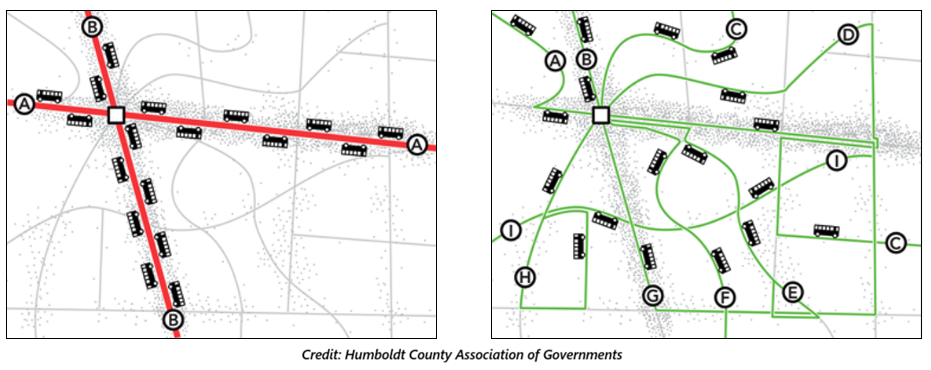
With limited funding, agencies like the Humboldt Transit Authority face a fundamental choice: should they increase the frequency of bus service in the core areas where more people live, or should they send buses on longer routes that reach more far-flung neighborhoods and communities? This dilemma is forced by a simple fact: a single bus can run a short route multiple times in the same amount of time it takes to run a longer route once. So with a limited budget and a limited number of buses, you can either have shorter routes with frequent service or longer routes with lower frequencies, but not both.
The implications of this choice are significant. More frequent buses in more densely populated areas are more convenient and attract more riders, which is why this approach is called the “ridership” model. But it also means nondrivers in lower-density areas don’t have access to transit. On the other hand, longer routes can provide access to nondrivers in more areas, but with lower frequencies they fail to attract new riders who have other transportation options. This is called the “coverage” model.
HTA is currently soliciting feedback on whether they should prioritize ridership or coverage in their future planning decisions. They have developed examples of what the bus system could look like in each scenario, but they caution that these are just examples and not actual proposed bus routes. Click here to learn more and take their survey.
CRTP is supporting a ridership approach that prioritized increased frequency in the more populated areas around Humboldt Bay. Here’s why:
- We can’t meet the region’s climate goals without attracting more riders to public transit.
- In our surveys of bus riders over the past year, increased frequency has been the most common request for improved service.
- While longer routes can reach more nondrivers, the infrequent service is inconvenient for everyone. Being near a bus stop doesn’t mean you have good transportation options if the bus only comes a few times a day.
- The more people ride the bus, the more political support there will be for bigger transit investments in the future.
This comes with one huge caveat: the tradeoffs between ridership and coverage are forced by a small and fixed transit budget. The more investments we make in transit, the better service we can provide to everyone!
Do you agree with our take? Do you disagree? Fill out HTA’s survey either way, and let us know what you think too!
Transit Survey-palooza!
If the ridership vs. coverage survey wasn’t enough for you, there are more opportunities to give you input on local public transit right now! You can report unmet transit needs through the Humboldt County Association of Government’s annual Unmet Transit Needs survey (or attend a hearing on the topic at next week’s Arcata City Council meeting), or weigh in on transit needs for older adults, people with disabilities, and people with low incomes through HCAOG’s Coordinated Public Transportation Plan survey.
If you’ve got a little more time and want to provide a North Coast perspective to researchers studying transit statewide, a team at UC Davis is looking for local participants for their “How Do People Receive Information About Public Transit?” project. Email Matthew Liu at masliu@ucdavis.edu for more information.
Vote by Tuesday!
Election Day is Tuesday! If you’re a registered voter, and you haven’t voted yet, make a plan right now to vote before it’s too late.
Local, state, and federal elections all have big impacts on the safety, equity, and sustainability of our transportation system. We encourage our members and supporters to do their research on candidates and ballot measures before voting. CRTP has taken the following positions on ballot measures this election:
- NO on Proposition 43. This measure would make it virtually impossible for local voters to raise money for things like transit service or bike and pedestrian infrastructure.
- NO on Proposition 45. This measure would gut the California Environmental Quality Act, removing critical environmental safeguards for projects ranging from highway expansions to sprawling subdivisions.
- YES on Arcata’s Measure G. Measure G renews an existing City of Arcata sales tax that has provided significant funding for bike and pedestrian infrastructure over the last two decades. The funding has helped support new crosswalks, bike lanes, sidewalks, and even the Humboldt Bay Trail and the Annie & Mary Trail.

Local Residents Protest Amazon Distribution Center Project
A crowd of people gathered to protest at the site of the proposed Amazon distribution center in McKinleyville last weekend. As at previous meetings and events, Amazon opponents raised a variety of concerns ranging from human rights to traffic.
CRTP opposes the Amazon distribution center project and supports efforts to stop its construction. Faster delivery, one of the project’s main goals, is one of the main drivers of climate pollution from online shopping. Additionally, anything that encourages online ordering undermines the emissions reductions that otherwise come from building homes within walking and biking distance of local shops.
The distribution center is also projected to generate 542 (mostly truck) trips in an area where there are several schools and many of the main transportation routes lack bike lanes or sidewalks. Without safety upgrades to local streets and roads, this new traffic would add to the dangers already faced by people walking, biking, and rolling in McKinleyville and other communities in the region.
One More Bike Valet Volunteer Opportunity!
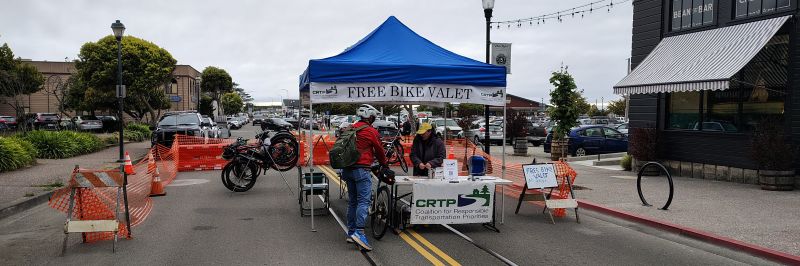
Event season is almost over, but CRTP is providing our free bike valet service at one more major community event.
California Care Force is bringing a free medical clinic to Eureka November 6th through 8th. The organizers predict lots of people arriving on bikes, and want to encourage even more. It’s a perfect fit for bike valet!
Since this is a three day event, we will need lots of volunteers to pull it off. If you can volunteer for a shift, please contact CRTP Bike Valet Coordinator (and 2026 Volunteer of the Year!) Jerry von Dohlen at crtpbikevalet@gmail.com.
Eureka Police Announce DUI Crackdown
We shouldn’t need the police to tell us. Don’t drink and drive. Don’t do drugs and drive. Just don’t.
Really, there’s no reason it should even be up to any of us to make that choice. Why not contact your elected representatives and ask for ignition interlock devices to come standard on all new vehicles?
News from Beyond the North Coast
Trump Administration Wants to Tie Transit Funding to Birth and Marriage Rates
If you read that headline and thought: Wait, what? – you’re not alone. But just in case this nonsensical idea is actually implemented, we thought you should know: no North Coast county has high enough birth or marriage rates to qualify for funding under the proposed rule.
Skyrocketing Fuel Prices Highlight the Cost of Car Dependence
For over a century, car companies have been selling us on the idea that cars provide freedom. But that’s not true – especially when you have no other options. Many Americans are now cutting back on groceries and other necessities because gas is so expensive, and they feel they have no viable transportation choices.
The Collector is CRTP’s weekly transportation news roundup, published every Friday. We focus on North Coast news, but we also include relevant state, national and international transportation news – plus other items that we just find kind of interesting! To submit items for consideration, email colin@transportationpriorities.org.