
The Collector
April 17, 2026
Why Eureka’s Parking Garage Plan Is a Really Bad Idea
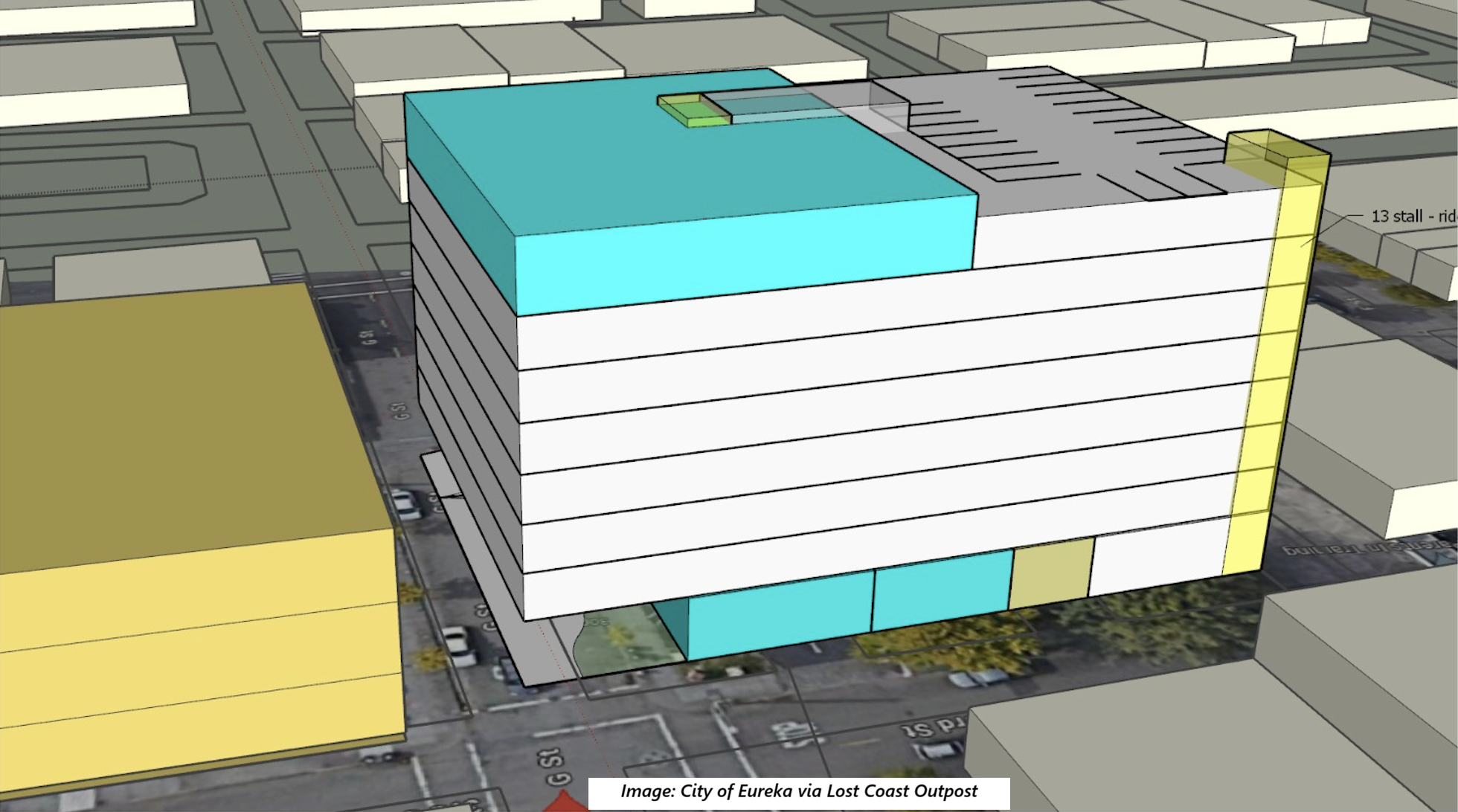
The Lost Coast Outpost reported last week that Eureka and the Humboldt Transit Authority (HTA) are considering building an 8-story, 216-stall parking garage downtown. For context, Eureka City Manager Miles Slattery noted that would probably make it the tallest building north of San Francisco.
As we pointed out when this concept was first floated back in 2023, a parking garage in downtown Eureka is a really bad idea for many reasons. We’ll list a few of them here:
- Parking garages are really expensive. A recent UCLA report found that above-ground garages cost an average of $52,000 per space to build. And the Victoria Transport Policy Institute estimates that parking spaces cost between $500 and $2,000/year to operate and maintain. Neither the city nor HTA could afford to build the proposed parking garage – which leads to reason number two that this is a bad idea.
- Transit money shouldn’t be spent on a parking garage. To pay for the project, the city and HTA would apply for a state grant meant to fund transit improvements. At a time when the need for transit service is rising, state and federal transit funding is declining, and HTA is being forced to backfill its budget with new Measure O funding just to maintain existing service, it should be inconceivable to local decision makers to use limited transit funding to build a parking garage rather than actually improving transit service.
- A “park-and-ride” in this location is doomed to fail. To justify using transit funds, the project would be called a “park-and-ride” and theoretically limited to use by people boarding a bus at the new transit hub across the street. But the concept of a park-and-ride is to collect suburban commuters for an efficient ride to jobs downtown. A feasible park-and-ride location is near residential areas and far from job centers, and provides competitive travel times compared to driving alone. No one is going to drive to downtown Eureka in order to get on a bus and go somewhere else – they’ll just keep driving.
- There is no need for this. More than a third of downtown Eureka is already covered with parking lots. There are already plenty of empty on-street and off-street spaces at any given time, despite the fact that most of the parking is free. And now that the city is beginning to more efficiently manage the downtown parking supply, it’s virtually certain that there will be even more parking spaces available in the future without building any more. Even if the garage were used (illegally) by non-bus riders, it’s likely that it would sit mostly empty most of the time, costing HTA maintenance and operations money that would otherwise go toward providing actual bus service.
- Bus riders, pedestrians, and bicyclists will pay the price. Even the best park-and-rides are inefficient subsidies for motorists. A downtown “park-and-ride” is even worse, because it uses up valuable real estate that could otherwise be used for desperately needed housing or services to make the area more walkable, bikeable, and transit-friendly. If homes were built on this site instead of parking spaces, the people who lived there would provide new riders for HTA and help support the improvement of bus service. In contrast, a parking garage would just be another ugly monolith for people to walk or bike past on their way to somewhere else.
CRTP will be working hard to make sure that transit funds are spent on improving transit service and that this proposal never comes to fruition.
Share Your Input on Bike and Pedestrian Safety Upgrades
In better news from Eureka, the city and Rural Communities Housing Development Corporation (RCHDC) are applying for a state grant to build affordable housing at the Sunset Heights site, above Broadway between Harris and Henderson Streets. If that sounds familiar, it’s because they applied for – and won! – a grant for the first phase of the same project just last year.
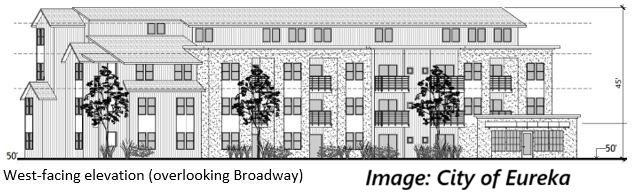
The state’s Affordable Housing and Sustainable Communities grant program funds not only housing, but also bike, pedestrian, and transit improvements in the surrounding neighborhood. You may recall the public outreach that was conducted last year to inform what improvements the first grant should cover. Now that more money could be coming, there are new opportunities to provide input!
This neighborhood has well-known traffic safety problems, as we were reminded this week when another pedestrian was struck by a driver on Harris Street just blocks from the new housing site. CRTP encourages Eureka residents – and anyone who might want to live in the new housing after it’s built – to fill out the city’s online survey and attend a community walk next Thursday at noon to help identify opportunities for bike and pedestrian improvements. And as always, you can also report hazardous locations on Street Story, which CRTP and the city both periodically review.
Share Your Ideas for a Better McKinleyville
Cal Poly Humboldt and the McKinleyville Municipal Advisory Committee are collecting “ideas to improve quality of life, sustainability, and/or economic growth for McKinleyville.” Want better sidewalks, protected bike lanes, calmer traffic, or better transit service? You can share your ideas at a listening session Saturday morning or submit specific ideas through this form.
Get Involved with CRTP!
Want to do more to support safe, fair, climate-friendly transportation on the North Coast? Here are some current opportunities.
- Share your transit story. Send us a paragraph or two about why you ride transit, how transit makes your life better, what you couldn’t do without it, how it could be better with more public support, and any other thoughts you want to share. Your story could help build support for more transit investment in our region!
- Sign the petition for safer 4th & 5th Streets in Eureka. We’re also looking for endorsements from organizations, businesses, and elected officials.
- Support CRTP. You can support CRTP by becoming a member or by buying a raffle ticket for a dual-battery BLIX cargo e-bike. To buy tickets, email cemone2@reninet.com or contact any CRTP Board Member. The drawing will be May 1st – the first day of Bike Month!
Temporary Hammond Trail Closure
McKinleyville bicyclists and pedestrians, take note: the Hammond Trail will be closed for maintenance next week between Murray Road and Knox Cove Avenue.
Arcata Committee to Discuss Lowering Speed Limits
Arcata’s Transportation Safety Committee will meet next week and consider whether to create a new subcommittee to guide the city toward lower speed limits. State laws passed in the last few years have created opportunities the city can take advantage of, poking some holes in the regulatory regime that historically made lowering speed limits practically impossible in most cases. Local governments can now reduce speed limits to 20 mph on many streets, and even to 15 mph in places with special safety needs.
News from Beyond the North Coast
“America Has No Transportation Engineers”
To get a degree to work as a transportation engineer in the United States, a civil engineering student often takes only one class: “Introduction to Highway Engineering.” It’s no wonder that they often don’t seem capable of solving the traffic safety crisis or building usable bike and pedestrian infrastructure. Doing those things requires an understanding of the complexities of how humans interact with the built environment, and our engineers just aren’t trained for that.
The Collector is CRTP’s weekly transportation news roundup, published every Friday. We focus on North Coast news, but we also include relevant state, national and international transportation news – plus other items that we just find kind of interesting! To submit items for consideration, email colin@transportationpriorities.org.