
The Collector
December 12, 2025
There’s Still Time to Tell Humboldt County Supervisors to Adopt a Robust Climate Action Plan
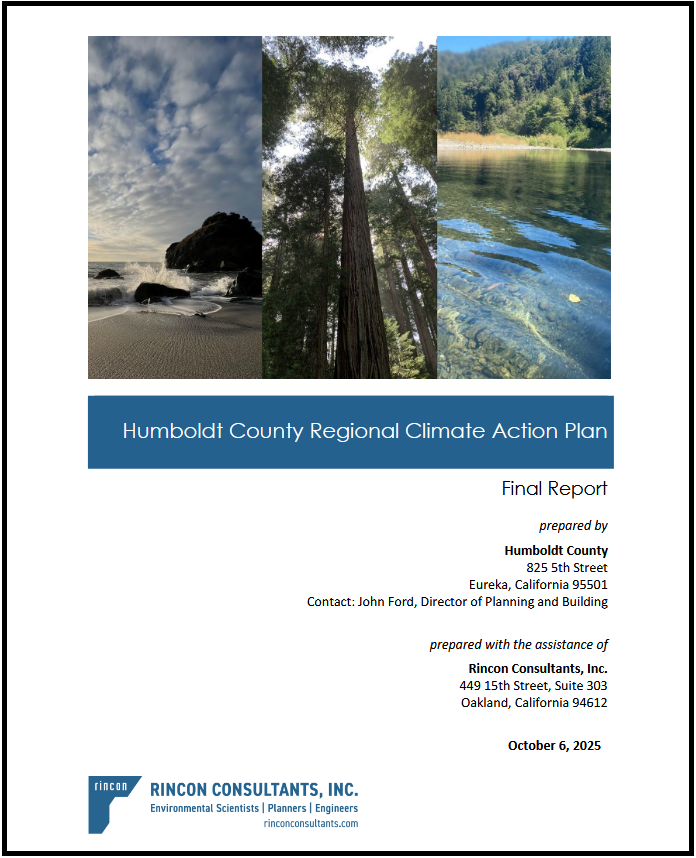
The Humboldt County Board of Supervisors is slated to adopt the Regional Climate Action Plan next Tuesday, and you can still weigh in! CRTP is joining our environmental allies in asking the supervisors to approve the plan, after making a few key changes. Here are our specific requests:
- Adopt greenhouse gas thresholds at the original levels recommended by the consultant, and reject the Planning Commission’s attempt to weaken this key standard for projects that aren’t compliant with the plan. (Check out EPIC’s great explanation of this issue here.)
- Ensure that only low-emission infill development projects will be considered compliant with the plan, so that high-emission rural developments aren’t exempted from analyzing and mitigating their climate impacts.
- Adopt and implement the plan without delay and without weakening it.
You can find a lot more detail in the letter CRTP and EPIC submitted to the Supervisors. We encourage CRTP’s supporters to email the Supervisors (you can find their emails here), and attend the Board of Supervisors meeting next Tuesday (December 16th), starting at 9:00 am in the Board of Supervisors Chamber, Humboldt County Courthouse, 825 Fifth Street, Eureka.
Take Action: Transportation Is at the Heart of the Climate Crisis
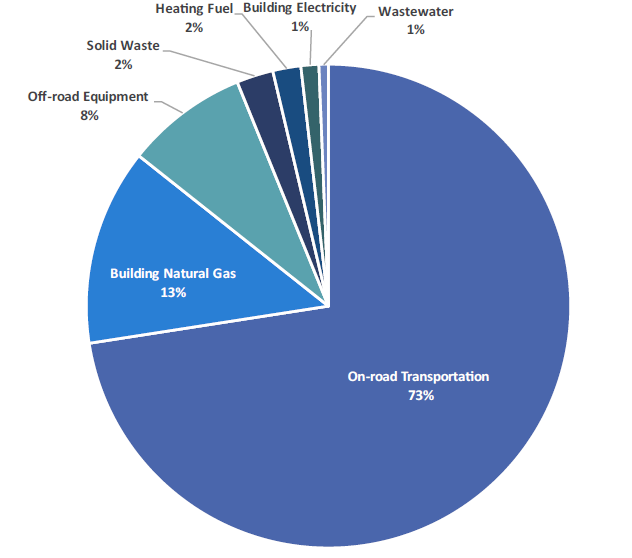
The Regional Climate Action Plan isn’t the only regional plan currently under consideration that will have a big effect on climate pollution. Transportation accounts for nearly three-quarters of local greenhouse gas emissions, which means Humboldt County’s Regional Transportation Plan is also crucial for the future of climate action in our region.
This plan is updated every four years by the Humboldt County Association of Governments (HCAOG), which is governed by a Board of representatives from the county and all seven of its incorporated cities. Unfortunately, the latest draft of the plan backs away from previous commitments to urgently needed climate progress.
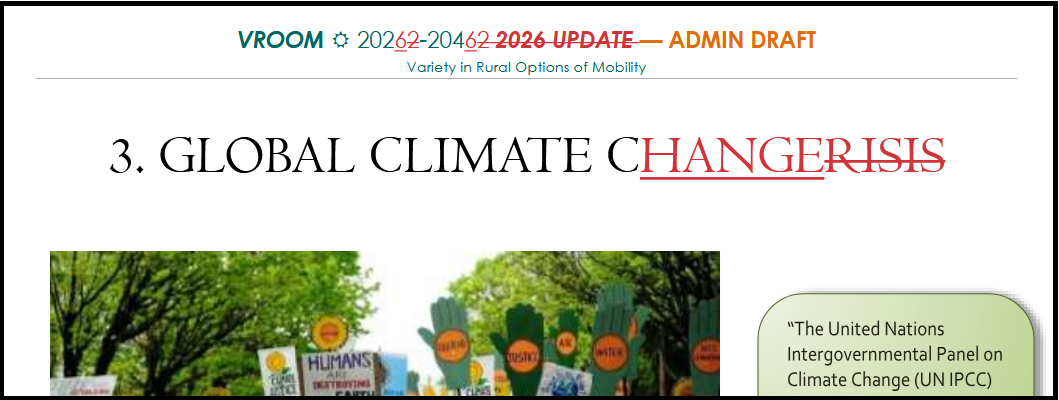
Shockingly, HCAOG is actually proposing to remove all uses of the phrase “climate crisis” from the draft plan, suggesting a troubling lack of understanding of the seriousness of climate change and the urgency of action. And it’s not just the language that has been changed. The new draft also kicks the can down the road by delaying commitments to build climate-friendly infill housing, purchase zero-emission vehicles, and develop EV charging stations.
Even worse, HCAOG is proposing to remove from the plan any commitment to ensuring that the projects they fund are actually consistent with their own goals for climate action and transportation safety.
With the federal government aggressively undermining climate action and trying to ensure the crisis only gets worse, local communities need to step up now more than ever. We can’t let our county and our cities backslide on climate at this critical moment in history.
We encourage everyone to take HCAOG’s official survey on the plan, and then to email HCAOG Board members and tell them to increase their commitment to climate action rather than abandoning their ambitions. You can find Board members’ emails here.
Here are some specific things you could say:
- Restore the use of the phrase “climate crisis” throughout the Regional Transportation Plan. Language matters, especially when it comes to important plans and policies.
- Don’t reverse climate progress. Keep existing targets for climate action, including climate-friendly infill housing. We need climate action now, not five years from now.
- Ensure that future funding decisions prioritize HCAOG’s own climate and safety goals. A plan is nothing more than words on paper if it doesn’t influence future decisions!
If you want to dive deeper, you can review the draft Regional Transportation Plan, read the official comments submitted by CRTP and our environmental allies, or read recent local media coverage of the issue. Comments are due by December 29th.
Housing Wins and Warning Signs
Walkable, transit-friendly, affordable housing in Eureka got two big boosts this week. First, the Sunset Heights affordable housing project, on the bluff above Broadway between Harris and Henderson Streets, secured a $21.7 million state grant. The money will not only allow the construction of 43 affordable homes near jobs and services, it will also pay for improved transit service as well as bike and pedestrian safety upgrades to some of the neighborhood’s most dangerous streets. CRTP is proud to have helped facilitate this grant application and excited to announce that a small portion of the funding will help us develop a new program at CRTP.
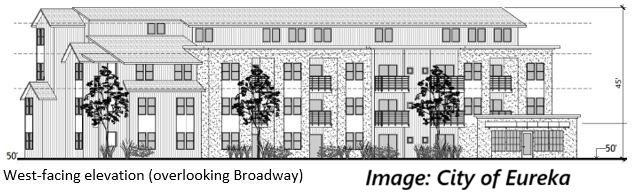
In breaking news today, we have also learned that the Humboldt Transit Authority and Danco have officially received the final funding needed for construction of the Eureka Regional Transportation and Housing Center (EaRTH Center), the long-awaited downtown transit hub with 45 affordable homes built right on top!
While we celebrate these wins for infill housing, we are also tracking warning signs that the county may be planning for more car-dependent, climate-wrecking sprawl. At their meeting this Tuesday, Humboldt County supervisors approved a grant application that, among other things, would fund studies of “improvements necessary to support potential subdivision and development along the Walnut Drive corridor between Cutten and Ridgewood.” Development in this area would have very little potential for walkability, bikeability, or high-quality transit – in other words, it would be sprawl. We will be advocating strongly for the county to support new housing in more sensible locations like Myrtletown and McKinleyville.
Trails! Trails! Trails!
Next Tuesday, the Great Redwood Trail Agency will be holding a virtual public meeting about its Master Plan for the future development of the trail from San Francisco Bay all the way around Humboldt Bay to Fairhaven. You can register for the meeting here, and submit questions in advance using this form.
Meanwhile, the Humboldt County Board of Supervisors took another step this week toward maintaining a crucial piece of existing trail infrastructure. The Hammond Trail bridge over Baduwa’t (Mad River) provides a safe connection between McKinleyville and Arcata for bicyclists and pedestrians, but is old and considered seismically vulnerable. Funding to replace it was secured by Congressman Jared Huffman two years ago, and on Tuesday the supervisors hired a consultant to develop engineering and environmental plans for the project.
Are We Really Still Doing the Big Box Thing?
According to media reports this week, Wal-Mart is in the process of buying the old K-Mart property on Broadway in Eureka. The property owner had previously agreed to sell the property to the county for a new permitting center, but apparently backed out after receiving an offer from Wal-Mart.
Wal-Mart stores are the epitome of car-dependent corporate development, with infamously large parking lots and predatory business practices. There’s a reason “big box” stores are not allowed in Arcata or the future McKinleyville Town Center. Why is Eureka still allowing, and even encouraging, this kind of development?
News from Beyond the North Coast
California’s Legislators Fail to Prioritize Transportation Safety
A new CalMatters investigation shows that, when presented with the fact that 40,000 people have died on California’s roads in the last decade and the number keeps rising, state legislators completely ignored this accelerating epidemic and decided instead to discuss issues like homeless encampments on state highways. It’s a stunning example of the lack of political will that is undermining efforts to eliminate traffic deaths. We know how to stop the carnage. The solutions – from better road design to intelligent speed assistance in vehicles – are well documented, and where governments invest in them, they work. But we will never make progress if our leaders keep ignoring the problem.
Statewide Task Force Recommends Transit Reforms
The California Transit Transformation Task Force has been meeting for the last two years. The group, created by a state law in 2023, was charged with charting a path forward to ensure robust and effective transit systems across the state, and determining how to avoid the fiscal crises facing many big systems. The task force’s official report has now been published. Among other things, it calls for new funding sources for transit and freeing transit operators from onerous state restrictions. Some of the recommendations can be implemented by transit agencies and local governments, but most will require the state legislature to take action.
About That Traffic Study…
When changes to local road or street designs are proposed, it’s usually not long before someone calls for a “traffic study.” Not unreasonably, people feel that we should know what will happen to car traffic after a project is built, and a study sounds like an official and scientific way to find out. But it turns out that most of the models used to conduct these studies are deeply flawed and fail to account for some of the most basic principles in transportation planning.
If You Build It, They Will Come
We’ve long known that building more highway lanes doesn’t alleviate congestion in the long term. Instead, it results in more people driving and filling up the lanes again, so congestion ends up at about the same level it was before. Recent research confirms that this phenomenon – called induced travel – happens with even small “congestion-reducing” projects, like adding a turn lane at an intersection. And it also applies to people walking and biking. Build more bike lanes, sidewalks, and trails, and people will walk, bike and roll more!
The Collector is CRTP’s weekly transportation news roundup, published every Friday. We focus on North Coast news, but we also include relevant state, national and international transportation news – plus other items that we just find kind of interesting! To submit items for consideration, email colin@transportationpriorities.org.